The word androgynous is a fascinating term that sits at the intersection of biology, fashion, and identity. Derived from the Ancient Greek words aner (man) and gyne (woman), it describes the combination of masculine and feminine characteristics into an ambiguous form.
1. Etymology and Meaning
At its core, androgyny refers to having both male and female traits. It isn't necessarily about being "neither"; rather, it is often about being both or occupying the space in between.
Linguistic Roots: Andro- (male) + -gyn (female).
Modern Usage: Today, it is most commonly used to describe a person’s appearance or style that doesn't clearly fit into traditional "boy" or "girl" categories.
2. Contexts of Use
The term is applied differently depending on whether you are talking about biology, art, or social identity.
In Fashion and Aesthetics
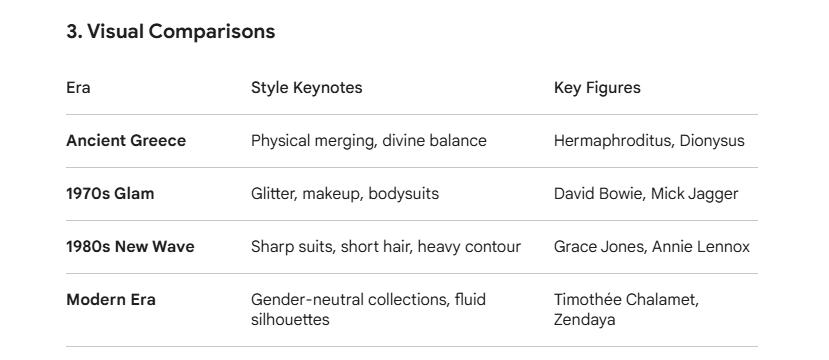
Androgyny in fashion is about breaking the "rules" of clothing. This might mean a woman wearing a sharp, tailored tuxedo or a man wearing soft fabrics and jewelry. High-fashion icons like David Bowie, Grace Jones, and Prince famously utilized androgyny to create a "gender-bending" look that challenged societal norms.
In Biology and Botany
In a scientific sense, androgyny (often referred to as hermaphroditism in some contexts, though the terms have distinct uses) describes organisms that possess both male and female reproductive organs.
Example: Many flowering plants are androgynous because they contain both stamens (male) and pistils (female).
In Psychology and Identity
Psychologically, androgyny refers to individuals who exhibit a high degree of both "masculine" traits (like assertiveness) and "feminine" traits (like empathy).
Gender Expression: While "androgynous" describes how someone looks or presents, it is different from "non-binary" or "genderfluid," which describe how someone identifies internally.
3. Why the Term Matters
Androgyny has historically been a tool for subversion and self-expression. By blending traits, people can move beyond the "gender binary"—the idea that there are only two ways to look or behave. It allows for a more flexible definition of beauty and personality.
How androgyny has influenced specific eras of pop culture and perhaps its roots in Greek mythology.
In both pop culture and Greek mythology, androgyny has been used to challenge the idea that "masculine" and "feminine" are opposites. Instead, these sources often present a blend of the two as a sign of completeness or otherworldly power.
1. Roots in Greek Mythology
The concept of androgyny in the Western world often traces back to two major myths.
The Myth of Hermaphroditus
According to legend, Hermaphroditus was the son of Hermes and Aphrodite. He was exceptionally handsome, and while traveling, he encountered a naiad (water nymph) named Salmacis. She fell in love with him, but he rejected her. When he bathed in her spring, she clung to him and prayed to the gods that they never be parted. The gods granted her wish by literally merging their bodies into one, creating a being with both male and female physical characteristics.
Plato’s "The Symposium"
One of the most famous philosophical takes on androgyny comes from Aristophanes’ speech in Plato’s Symposium. He suggested that original humans were spherical beings with two faces, four arms, and four legs.
These beings came in three genders: Male-Male, Female-Female, and Androgynous (Male-Female).
Fearing their power, Zeus split them all in half.
According to the myth, we spend our lives searching for our "other half" to feel whole again.
2. Influence on Pop Culture
In modern history, androgyny has been a powerful tool for artists to project mystery, rebellion, and a rejection of social "boxes."
The 1970s and 80s: The Glam Rock Era
This was the peak of androgyny in mainstream media. Artists like David Bowie (as Ziggy Stardust) and Prince used makeup, high heels, and lace combined with traditional masculine energy to create a "third way" of existing.
The Goal: To look "alien" or "angelic"—something that transcended human expectations of gender.
The 1990s: The "Heroin Chic" and Grunge Look
In the 90s, androgyny shifted from "glam" to "minimalist." Fashion icons like Kate Moss and musicians like Kurt Cobain popularized a waifish, desaturated look. Men wore dresses (like Cobain on stage), and women wore oversized, shapeless "boyfriend" flannels, blurring the lines of the silhouette.
Today: High Fashion and Fluidity
Contemporary figures like Tilda Swinton, Harry Styles, and Janelle Monáe have brought androgyny into the 21st century. It is no longer just a "costume" for the stage; it has become a lifestyle and a political statement about the fluidity of identity.
In Jewish folklore and mystical tradition, there is a fascinating concept that the first human was not created as a single man, but as an androgynous being.
This idea primarily stems from the tension between the two different creation stories found in the first two chapters of Genesis (Bereshit).
1. The Dual Creation Accounts
In Genesis 1:27, the text says:
"So God created mankind in his own image, in the image of God he created them; male and female he created them."
Then, in Genesis 2, the text describes Adam being created from the dust, followed later by the creation of Eve from Adam’s side (or rib).
To reconcile these two accounts, early Jewish sages proposed that the "first Adam" in Genesis 1 was a single entity containing both sexes.
2. The Midrash of the "Androgynos"
The Midrash (a collection of rabbinic interpretations) contains a famous explanation by Rabbi Jeremiah ben Leazar. He suggested that when God created the first human, God created an Androgynos (a Greek-derived term used in the Talmud).
The Physical Form: Some interpretations describe this original being as having two faces—one male and one female—looking in opposite directions.
The Separation: In this view, what is often translated as "taking a rib" in Genesis 2 is interpreted as "taking a side." God didn't just take a bone; He literally split the two-sided being in half.
The Result: Man and woman were then "built" into separate individuals, and their natural pull toward one another in life is seen as an attempt to regain that original, lost wholeness.
3. The "Adam Kadmon" in Kabbalah
In Kabbalah (Jewish mysticism), this concept is elevated to a spiritual level. The "Primordial Man," or Adam Kadmon, is seen as a divine blueprint that transcends physical gender.
The Sefirot: The divine attributes of God (the Sefirot) are often categorized as "masculine" (representing giving/outflow) and "feminine" (representing receiving/nurturing).
Balance: A core goal in Jewish mysticism is the "unification" (yichud) of these energies. The androgynous nature of the first human reflects the belief that the Divine itself contains the perfection of both qualities in one.
4. Why This Interpretation Exists
This folkloric approach serves a few symbolic purposes:
Equality: It suggests that man and woman were created simultaneously from the same essence, rather than one being a "secondary" addition to the other.
Unity: It explains the deep human desire for companionship as a return to a primal state of being "one."
Divine Reflection: Since God has no physical body and no gender, a being that contains both masculine and feminine traits is seen as a more accurate "image of God."
How the Talmud treats the legal status of the Androgynos, and how this theme shows up in more modern literary works.
The legal and social status of the Androgynos in the Talmud is surprisingly detailed. Rather than ignoring or dismissing people who didn't fit the gender binary, the ancient rabbis created a complex legal framework to ensure they had a place within the community's laws (Halacha).
1. The Four Gender Categories in the Talmud
The Mishnah (the core of the Talmud) identifies several categories beyond "male" and "female." The two most relevant to androgyny are:
Androgynos: A person who possesses both male and female physical characteristics.
Tumtum: A person whose physical characteristics are "hidden" or indeterminate.
2. The Legal "Middle Ground"
In Tractate Bikkurim, the rabbis debate the status of an Androgynos. They concluded that this person is neither purely male nor purely female, but a "distinct creation" (beriyah bifnei atzmah).
Because Jewish law has different obligations for men and women, the rabbis applied a "stringency" rule: an Androgynos is often required to follow the laws of both genders to ensure all bases are covered.
Where they are like men:
They are obligated to fulfill all positive "time-bound" commandments (like wearing tzitzit or hearing the Shofar).
They can inherit property in the same way a son does.
Where they are like women:
They must separate themselves during certain biological cycles.
They are restricted from certain roles that were traditionally male-only in that era (such as serving as a priest in the Temple).
A Note on Compassion: While these laws are technical, the Talmudic discussions often emphasize that an Androgynos is a full member of the covenant. One famous passage notes that God "loves the Androgynos as much as anyone else" because they represent a unique manifestation of divine creation.
3. Androgyny in Modern Literature
In the 20th and 21st centuries, writers have used the concept of androgyny to explore the limits of human identity and the possibility of a "universal" person.
Virginia Woolf's Orlando (1928)
Perhaps the most famous literary exploration of androgyny. The protagonist, Orlando, lives for centuries, beginning life as an Elizabethan nobleman and eventually waking up as a woman.
The Theme: Woolf argues that the "greatest" minds are androgynous. She famously wrote, "It is fatal to be a man or woman pure and simple; one must be woman-manly or man-womanly."
Ursula K. Le Guin's The Left Hand of Darkness (1969)
In this sci-fi masterpiece, the inhabitants of the planet Gethen are "ambisexual." They have no fixed gender for most of their lives, only taking on male or female characteristics during a specific fertile period.
The Theme: Le Guin uses this to ask: What is left of a human being when you take away gender? It explores a society built on cooperation rather than "masculine" or "feminine" power dynamics.
Jeffrey Eugenides' Middlesex (2002)
This Pulitzer Prize-winning novel follows a Greek-American narrator named Cal, who is intersex.
The Theme: It weaves together family history, biology, and the search for self, modernizing the ancient myths of "merging" and "splitting" into a contemporary American setting.
Summary Table: Perspectives on Androgyny
Lens Core Idea
Ancient Law A unique "third" category with dual obligations.
Literature A symbol of mental wholeness and social freedom.
Philosophy The ideal state of a human who is not limited by a single perspective.
How these themes of "oneness" and "balance" are used in modern Jewish poetry or art.
In modern Jewish art and poetry, the concept of the Androgynos has moved from the pages of ancient law into a powerful symbol of spiritual wholeness and personal identity. Many contemporary artists use it to bridge the gap between tradition and the modern self.
1. Modern Poetry: The Search for the "Other Half"
Contemporary Jewish poets often revisit the Midrash of the split being to talk about the feeling of incompleteness or the desire for connection.
Joy Ladin: As a prominent Jewish transgender poet, Ladin often writes about the transition from a "split" self to a "whole" self. Her work mirrors the idea of the Adam Kadmon—a primordial soul that exists before it is defined by a body.
The Theme of "Returning": Many poets use the image of the "two-faced" original human to describe the complexity of modern life—having one face looking toward ancient tradition and the other toward the future.
"We were one body once, then two, now a million fragments searching for the original light." (A common motif in mystical-leaning modern verse).
2. Visual Art: Reimagining the Divine Image
Jewish artists have used visual media to challenge the way we "see" gender in a religious context.
The Work of Yauheni (Eugene) Kotlyar
Many artists influenced by Eastern European Jewish traditions have created illustrations of the Sephirot (the Tree of Life) that intentionally blend masculine and feminine features. They depict the "Divine Human" not as a man, but as a balanced, androgynous figure.
Photography and Performance
The "Tallis" Imagery: Some modern Jewish photographers have created series showing individuals in traditional garments (like the tallit or tefillin) who present androgynously.
The Message: These images reclaim the "Androgynos" of the Talmud, suggesting that one doesn't have to be "purely" male or female to participate in the most sacred rituals of the faith.
3. Androgyny as "Tikkun" (Healing)
In the Jewish concept of Tikkun Olam (repairing the world), some thinkers suggest that our world is "broken" because we have separated everything into rigid categories (Male/Female, Holy/Profane, Light/Dark).
The Artistic Goal: By creating androgynous art, these creators are performing a symbolic "repair."
They are trying to "put the pieces back together" to reach that original state of balance described in Genesis 1.
Why This Matters Now
This shift in art and poetry shows that androgyny isn't just an ancient curiosity; it’s a living tool for people to find themselves within their heritage. It turns a "legal category" into a "spiritual aspiration."
How It Connects Back to You:
Earlier, you asked about prayers for commemoration and mourning. Interestingly, some modern memorial services use this "androgynous" imagery to describe the soul as it leaves the body—suggesting that in the afterlife, the soul returns to its original, genderless, and unified state.
A Quick Comparison
Feature Ancient View (Talmud) Modern View (Art/Poetry)
Focus Legal status and obligations. Identity and spiritual wholeness.
Tone Technical and protective. Expressive and rebellious.
Goal Where does this person fit in the community? How does this person find themselves in the Divine?
Some specific examples of modern Jewish liturgy or prayers that have been updated to reflect this more inclusive, "androgynous" view of the soul.
In recent decades, Jewish liturgy has evolved to better reflect the "androgynous" or non-binary nature of the soul. This is often seen as a return to the mystical idea that the soul (Neshamah) is a spark of the Divine and therefore transcends physical gender.
Here is how these concepts are being integrated into modern prayer and ritual.
1. Gender-Neutral Language for the Divine
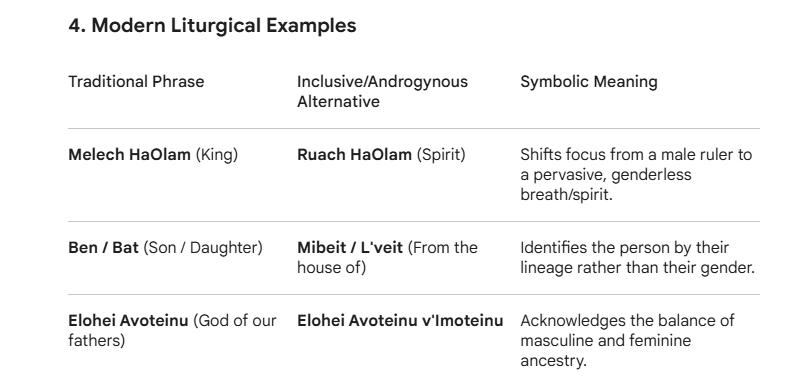
Many modern prayer books (Siddurim), such as those used in Reform, Reconstructionist, and Renewal communities, have shifted away from exclusively masculine pronouns for God.
The Concept: Instead of "He" (Hu), liturgy may use "Ya" (a name for God that blends masculine and feminine sounds) or alternate between Baruch (masculine) and Berucha (feminine).
The Connection: By making God "androgynous" in language, the liturgy reinforces the idea that all humans—regardless of their gender expression—are equally made in the Divine image.
2. Updated Commemoration and Mourning
You previously asked about prayers like the Kaddish or El Malei Rachamim (the prayer for the soul of the deceased). In modern settings, these are being adapted for those who identified as non-binary or for those who wish to emphasize the genderless nature of the soul.
The "Androgynos" Kaddish
Traditional Hebrew is highly gendered (son/daughter, king/queen). Modern adaptations use a few different strategies:
Plurality: Using the Hebrew plural L'chayim (to life) as a neutral descriptor.
Direct Addressing: Using the term "Mibeit" (from the house of) followed by the parents' names, rather than "son of" (ben) or "daughter of" (bat).
The Soul's Return: The prayer El Malei Rachamim (God full of Compassion) is increasingly recited using neutral phrasing to suggest the soul is returning to its "original, unified state" (Adam Kadmon).
3. The Ritual of "Brit Shalom"
For new parents who want to honor the ancient concept of the Androgynos from the Midrash, some have moved toward a Brit Shalom (Covenant of Peace).
This is a naming ceremony that focuses on the child as a "sacred soul" before social gender roles are applied.
The liturgy often includes the Genesis 1 verse: "Male and female God created them," emphasizing that the child contains the potential for all human qualities.
A Closing Thought on Wholeness
In many of these modern prayers, the goal is Shalom—which comes from the root Shalem, meaning "whole." The use of androgynous imagery is seen as a way to make the community "whole" by ensuring no one is excluded from the sacred language.
How these inclusive themes are specifically handled in a modern version of the Yizkor (Remembrance) service.
The Yizkor service, traditionally held four times a year, is one of the most emotionally charged moments in Jewish liturgy. In modern, inclusive communities, the service has been adapted to honor the "androgynous" or gender-transcendent nature of the soul, moving away from rigid "son/daughter" or "father/mother" binaries when appropriate.
Here is how these themes of wholeness and balance are integrated into a modern Yizkor.
1. The Language of the Soul (Neshamah)
In Hebrew, the word for soul, Neshamah, is grammatically feminine, but it is understood to be the part of a human that has no gender. Modern Yizkor services lean into this by focusing on the soul's return to a unified state.
The Shift: Instead of focusing on the physical person (man or woman), the prayers focus on the Nitzotz (Divine Spark).
The "Neutral" Opening: Some modern prayer books open the service with a meditation on the Adam Kadmon (the primordial, unified human), suggesting that in death, all divisions—including gender—dissolve back into the Divine One.
2. Inclusive Memorial Formulas
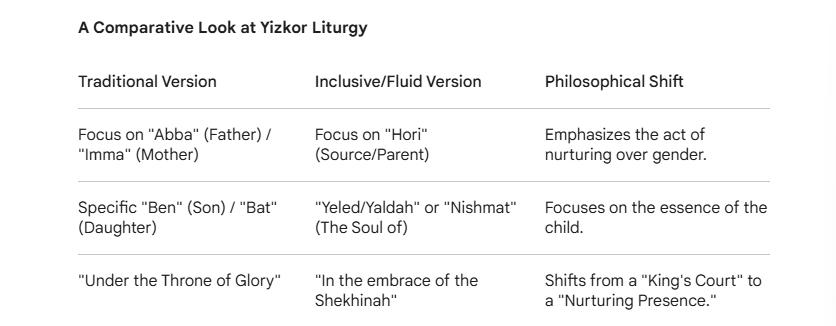
The central prayer of Yizkor usually begins with "Yizkor Elohim..." (May God remember...). Traditionally, you would insert "the soul of my father/mother/son/daughter."
Modern adaptations use:
Zcher/Zichrah: Using both masculine and feminine forms of "remembrance" in the same sentence to create a "linguistic embrace" of all gender possibilities.
Parental Neutrality: Using "Hori" (my parent) or "Yuldi" (the one who birthed/raised me) to honor the relationship rather than the gender role.
The "Androgynos" Inclusion: In some Sephardic and contemporary Ashkenazi rituals, a specific line is added to remember "those who lived between categories," ensuring that individuals who were androgynous or non-binary in life are named and honored accurately.
3. The "El Malei Rachamim" (God Full of Compassion)
This is the climactic memorial prayer. In a modern, inclusive service, it is often adjusted to reflect a more fluid view of the Divine:
"God, full of compassion, who dwells on high... grant perfect rest under the wings of the Shekhinah (the Divine Presence)."
Shekhinah as the "Feminine" Divine: By emphasizing the Shekhinah, the prayer introduces a feminine energy to balance the traditionally masculine Elohim.
The Wings of Peace: The "wings" are seen as a place where the soul is no longer "man" or "woman," but simply a "holy being" (Beryiah Kedoshah).
4. Why This Matters for Commemoration
Using inclusive or androgynous imagery in mourning serves a psychological and spiritual purpose:
1. Universality: It suggests that grief is a universal human experience that transcends the boxes we put ourselves in during life.
2. Healing (Tikkun): It honors the deceased for who they truly were, especially if they didn't fit traditional molds.
3. Spiritual Return: It reinforces the idea that we all come from the same "One" and return to that same "One."
We have journeyed from the linguistic roots of androgyny to Greek myths, the "split" human in the Midrash, and finally into the modern prayers for the dead.
Gemini may display inaccurate info, including about people, so double-check its responses.